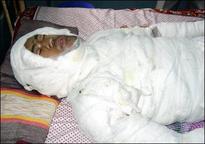
Chittaranjan doused himself with kerosene and set himself ablaze August 15.

Taking Kharg would give the US control over virtually all of Iran's oil exports and thus provide significant leverage, notes Prem Panicker in his must read daily blog on the Gulf War. It would also put American troops within range of Iran's remaining missiles, drones, and artillery on a piece of real estate that is just eight square miles in size, and just 15 miles from the Iranian mainland.

It was a simple function and the families of the bride and groom were absent.

Patil is likely to hold discussions with representatives of the groups involved in the agitation, senior security officials and state leaders.
Sikandar Raza's superb all-round show, a blazing 73 and three key wickets, kept Zimbabwe in the contest before South Africa steadied nerves to seal a five-wicket win and book a T20 World Cup semi-final clash with New Zealand.
Terming the Armed Forces Special Powers Act as an 'essential instrument,' Minister of State for Defence M M Pallam Raju on Tuesday said the army was being 'demonised' and made a 'scapegoat' in Jammu and Kashmir affairs which are mainly linked to the peoples' 'aspirations.'
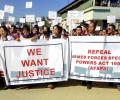
The resolution moved by Chief Minister Neiphiu Rio was adopted by voice vote during the one-day special session of the Assembly held to discuss the AFSPA, 1958, and its application to Nagaland in the aftermath of the killing of 14 civilians by security forces, including six in a botched anti-terrorist operation, and eight others in subsequent incidents in Mon district on December 4 and 5.
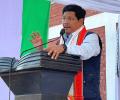
AFSPA confers special powers on the armed forces in areas deemed as disturbed.
Civil society groups in insurgency-hit Manipur have been carrying on with their campaign for withdrawal of 'draconian' 1958 Armed Forces Special Powers Act, alleging that security forces operating in the state often resort to excesses taking advantage of the Act in force.
It termed the protest against the Armed Forces (Special Powers)\n\nAct, 1958, as an 'emotional outburst'.\n\n

He said that those who have surrendered and returned to the mainstream are being rehabilitated by both the central and Assam governments and they will participate in the development journey of the state.
Union Home Minister Amit Shah has reviewed the security situation in Manipur for the second consecutive day, directing officials to focus on restoring peace and order in the state. The situation has been volatile following protests and violence after the recovery of bodies of women and children. Shah also ordered the deployment of 5,000 paramilitary troops to assist the state government in handling the situation.
The Tripura government has extended implementation of Armed Forces Special Powers Act for another six months to take stringent action against militancy in the state, official sources said on Sunday.

The mother of Janata Dal-United MLA Kh Joykishan Singh in Manipur has lodged a complaint, alleging that Rs 18 lakh in cash and jewellery items worth Rs 1.5 crore were looted by a mob that vandalised the legislator's residence on November 16, police said on Thursday.
The Central Reserve Police Force has sought the cover of Armed Forces (Special Powers) Act for its men conducting anti-Naxal operations at a time when continuance of the controversial Act in areas of Jammu and Kashmir and the North East is being debated.
'Sadly, we don't have a single political leader in any party who carries any kind of conviction in Kashmir.'
Ruling coalition partner People's Democratic Party on Sunday sought a special Cabinet meeting to discuss demilitarisation and withdrawal of Armed Forces Special Powers Act.
The Cabinet Committee on Security (CCS) will meet in New Delhi on Saturday amid indications that the controversial Armed Forces Special Powers Act (AFSPA) could be partially withdrawn from Kashmir and Jammu, an issue that was deliberated upon by the top Congress leadership on Friday.
Amidst raging debate over Jammu and Kashmir government's intention to revoke Armed Forces Special Powers Act from parts of the state, Army on Thursday made its case clear saying any such move will handicap the capability of the force to conduct counter insurgency operations.

The defence minister, however, said the matter is under the domain of the Union home ministry and it will take appropriate decisions.
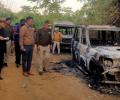
The AFSPA is in force in Assam, Nagaland, Manipur (excluding Imphal Municipal Council Area), Changlang, Longding and Tirap districts of Arunachal Pradesh, and areas falling within the jurisdiction of eight police stations of districts in Arunachal Pradesh bordering Assam.
At least five civilians were injured in yet another hand grenade explosion in south Kashmir town of Bejibehara, 45 kms from Srinagar on Wednesday afternoon.
The Armed Forces Special Powers Act and the Disturbed Areas Act will be revoked from some areas of Jammu and Kashmir within the next few days, Chief Minster Omar Abdullah said on Friday. While assuring the people that revocation of these laws will not have any adverse affects, he said the measure will put an added responsibility on the shoulders of state police and paramilitary forces.
Cabinet Secretary Ajit Kumar Seth, Defence Secretary Shashikant Sharma and Home Secretary RK Singh were taken by surprise when the Army's Northern Command told them that there had been no consultations on the subject of revocation of the AFSPA even once in 2011. The chief minister's declaration was totally unilateral, the three top secretaries to the Government of India were told
In an exclusive interview, Maj-Gen Sudhir Vombatkere (retd), who was additional director general for discipline and vigilance at the Army headquarters with the human rights cell, tells Bula Devi that the AFSPA should be used only for brief and limited periods and only to facilitate specific missions.
In an exclusive interview, Maj-Gen Sudhir Vombatkere (retd), who was additional director general for discipline and vigilance at the Army headquarters with the human rights cell, tells Bula Devi that the AFSPA should be used only for brief and limited periods and only to facilitate specific missions.

Manipur witness more violence on Tuesday when unidentified armed men, suspected to be cadres of banned terror groups, attacked people from the tribal community in the morning killing three of them in Kangpokpi district, officials said.

Fight on toward goals that keep receding, or exit with most objectives unmet. Trump is agitated, his poll numbers falling below the Plimsoll line, his base fractured between those who back the war and those who remember that he campaigned on ending them.
Home Minister P Chidambaram on Friday said his position on controversial Armed Forces Special Powers Act in Jammu and Kashmir has not changed and the Centre is considering three amendments proposed by his ministry to the Act.

Making a strong pitch for phased removal of the controversial Armed Forces (Special Powers) Act, Jammu and Kashmir Chief Minister Omar Abdullah Wednesday asked the Centre to set in motion a mechanism which could guide in repealing of the act from the state.
Mehbooba Mufti, president of Peoples Democratic Party, the main opposition in Jammu and Kashmir, on Monday said that by ruling out reduction of troops and revocation of the Armed Forces Special Powers Act, the Union government was compromising the fundamentals of the country's standing as a democratic nation.

Stressing on "progressively" decreasing the footprints of security forces in Jammu and Kashmir, Chief Minister Omar Abdullah on Monday said conciliation and dialogue will always remain the best medium for seeking a solution to all contentious issues.
Kashmiri separatists on Monday rejected the suggestion made by the Jamiat Ulema-i-Hind, the powerful body of Deobandi clerics, at its Kashmir conference at Deoband that 'the issue should be resolved within the parameters of the Constitution of India.'
Activist Irom Sharmila Chanu, who was on Monday charged with attempting suicide for her fast unto death here in 2006 while demanding repeal of the controversial Armed Forces Special Powers Act, said she is following Mahatma Gandhi's principle of non-violence and should not be "discriminated" against.
After his tough talk with the army for withdrawing Armed Forces Special Powers Act from parts of Jammu and Kashmir, Chief Minister Omar Abdullah on Thursday said his government has the authority to revoke the controversial law and sought a 'workable' solution from the army.
The ruling Congress has pledged to improve the law and order situation in Manipur and withdraw the controversial Armed Forces Special Powers Act if voted to power in the assembly election.
Irom Sharmila, has been fasting for 9 years against a controversial law.

Phase-wise revocation of the controversial Armed Forces (Special Powers) Act and return of power projects to Jammu and Kashmir are the two most important wishes of Chief Minister Omar Abdullah.
Army Chief General V K Singh has said people asking for withdrawal or dilution of the Armed Forces Special Powers Act in Jammu and Kashmir are doing it for "narrow political gains".
